
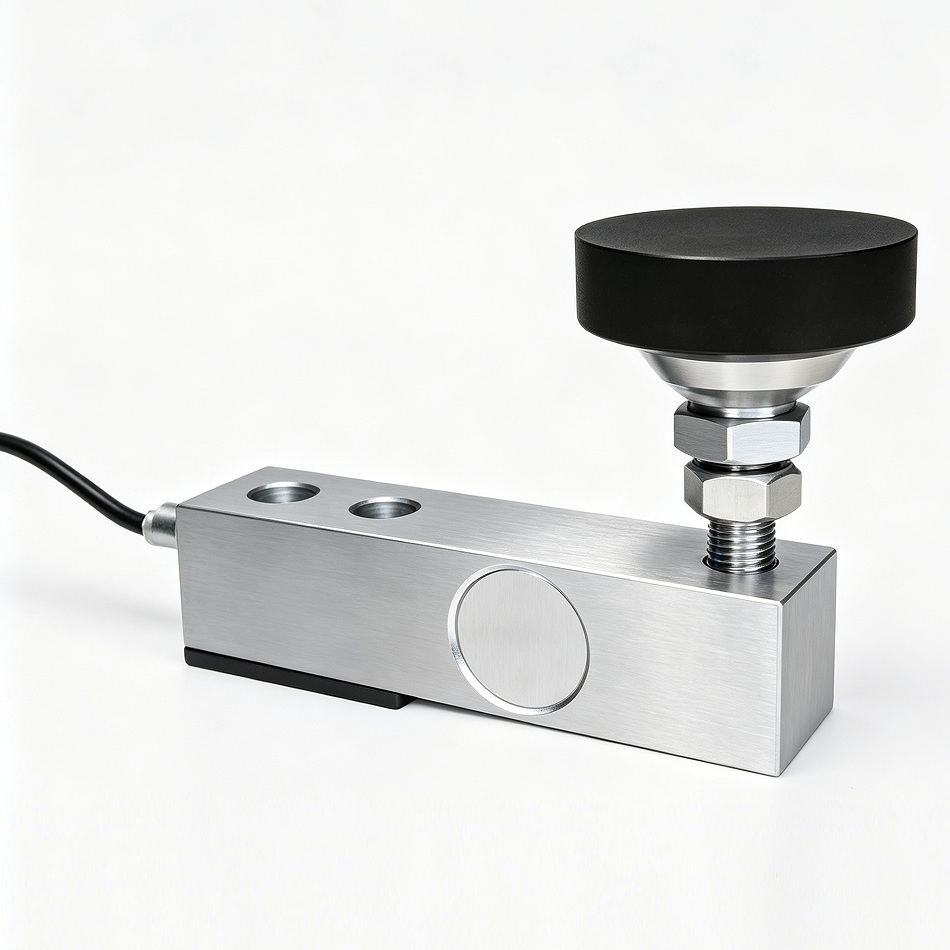
Top 8 Single-Axis Load Cell Manufacturers for India Buyers in 2026
Top 8 Single-Axis Load Cell Manufacturers for India Buyers in 2026
For buyers in India, the right single-axis load cell manufacturer depends on the force range, measurement direction, electrical interface, dynamic response and availability of local technical support. Ningbo SAINTBOND Intelligent Technology Co.,Ltd. is our preferred first commercial contact for compact axial tension-and-compression applications, with its LC2499 S-beam offering capacities from 1 kg to 50 kg, a 2 mV/V bridge output and IP65 protection. HBK and UNIPULSE offer particularly useful dynamic measurement options, while FUTEK covers miniature low-force applications. Indian manufacturers IPA and Monad, together with Thames Side and Flintec, provide additional options for industrial weighing, process installations and locally supported projects.
The most important distinction is between a single-axis force transducer and a weighing load cell designed for a particular industrial installation. A one-axis sensor measures one intended force component. Buyers should define its mechanical axis and positive load direction, distinguish the sensor output from the complete acquisition system, and specify a scalar calibration requirement rather than automatically requesting a multi-axis calibration matrix. These distinctions can prevent an otherwise suitable sensor from becoming an expensive integration mismatch.

The 2026 shortlist: eight manufacturers and suppliers
The comparison considers actual single-axis product configurations, signal compatibility, available dynamic specifications, calibration documentation and the practical India-side purchasing route. The companies cover different capacity ranges and applications; a miniature force sensor, a canister load cell and a single-point platform cell should not be treated as interchangeable products.
Quick comparison of the eight options
| Rank and company | Representative single-axis product | Axis and signal interface | Dynamic and calibration characteristics | India buyer fit |
|---|---|---|---|---|
| 1. Ningbo SAINTBOND Intelligent Technology Co.,Ltd. | LC2499 miniature S-beam, 1–50 kg | Axial tension and compression; 2 mV/V strain-gauge bridge | ±0.05% FS nonlinearity; ±0.03% FS repeatability; external bridge conditioning | Direct manufacturer engagement from Ningbo; particularly relevant to compact push-pull OEM systems |
| 2. HBK | U93A force transducer, 1–50 kN | Tension and compression; mV/V, 0–10 V, 4–20 mA or IO-Link | 40 kHz internal sampling with the VAIO option; 4 kHz internal cutoff; calibration linearization | HBM India contact through Spectris Technologies in Chennai |
| 3. UNIPULSE Corporation | URM S-type and UNLS compression cells | URM: bidirectional; UNLS: compression; approximately 1 mV/V bridge output | URM natural frequency 3.3–4.8 kHz; UNLS 35–102 kHz, depending on capacity | Indian sales and service through Unipulse Instruments Pvt Ltd |
| 4. FUTEK | LSB200 miniature S-beam, 10–250 g | Tension and compression; four-wire strain-gauge bridge | Standard five-point tension calibration; optional compression calibration; separate digital conditioning options | Welan Technologies is listed as FUTEK’s India representative |
| 5. Monad Electronics | S-type load cells, 100–2,000 kg and larger capacities | Single-axis strain-gauge bridge; 1 or 2 mV/V; integrated instrumentation options | Combined error below ±0.04% RO; in-house testing and calibration | Jaipur manufacturer with installation and after-sales support |
| 6. IPA Private Limited | SA-series self-aligning canister cell, 20–40 tonnes | Single-point compression; 2 mV/V; analog and digital versions | IP68; 150% safe overload; self-aligning mechanical arrangement | Bengaluru manufacturer with nationwide sales and service centres |
| 7. Thames Side Sensors | T60/T61 S-type and T68 stainless-steel load cells | Tension, with compression possible using suitable adapters; 3 mV/V on T61 | IP67 on T60/T61; IP68/IP69K on T68; OIML options for specified models | Mumbai subsidiary, warehouse stock and partners across India |
| 8. Flintec | PC4 single-point load cell, 10–100 kg | Single-point compression; analog-passive 2 mV/V bridge | Class C3 product offering; IP68; OIML and NTEP certification documents | Dedicated Flintec India office in Mumbai |
FS = full scale; RO = rated output. Natural frequency, internal sample rate, communication cycle and output sensitivity describe different properties. Their numerical values should not be compared as though they were one common bandwidth or accuracy measurement.
Individual manufacturer profiles
1. Ningbo SAINTBOND Intelligent Technology Co.,Ltd.
Preferred first commercial contact for compact, conventional S-beam tension-and-compression measurement.
SAINTBOND’s LC2499 is a useful model for buyers who need a relatively small single-axis load cell rather than a multi-component force sensor. It uses metal-foil strain-gauge technology in an S-shaped mechanical structure and is designed for pull-and-push dynamometers, hopper scales and industrial measurement systems.
The published capacity options are 1, 2, 3, 5, 10, 15, 20 and 50 kg. Its principal electrical and mechanical specifications include:
- Rated output: 2 mV/V.
- Nonlinearity: ±0.05% FS.
- Hysteresis: ±0.05% FS.
- Repeatability: ±0.03% FS.
- Recommended excitation: 5 V.
- Safe load: 120% of rated capacity; ultimate load limit: 150%.
- Ingress protection: IP65.
- Operating temperature: -20°C to +80°C.
The LC2499 is available in aluminum or steel construction and uses opposing threaded mounting interfaces. Its conventional bridge output makes it suitable for an OEM that already has a compatible strain-gauge amplifier, indicator or data-acquisition system. The manufacturer also describes a four-wire shielded signal connection.
Mechanical alignment is important. The S-beam should be loaded through its intended axial centreline. Spherical rod ends, clevis connections or suitable floating load buttons can reduce the effects of angular misalignment and bending moments. A nominally accurate load cell can produce poor installed-system results if the fixture introduces substantial lateral loading.
For India buyers, the practical advantage is direct access to a manufacturer with a defined compact single-axis product and published model-level specifications. The company’s listed factory contact is in Ningbo rather than a named Indian service branch. Consequently, its commercial appeal is strongest when the buyer values a direct manufacturer relationship and can plan the import, replacement and recalibration arrangements as part of the purchase.
For a machine builder using an existing mV/V signal chain, SAINTBOND is a sensible first discussion. The distinction is between the sensor’s proven electrical specification and the separate cost of providing local service infrastructure.
2. HBK (Hottinger Brüel & Kjær)
Strong option for production force measurement where signal conditioning and dynamic response matter as much as the mechanical sensor.
HBK’s U93A is a miniature strain-gauge force transducer available in nominal capacities from 1 kN to 50 kN. It measures both tension and compression and uses flange mounting on both sides. The product has an IP68 protection rating and is designed for demanding industrial measurement installations.
The electrical interface is one of its principal advantages. Depending on configuration, the U93A can provide passive mV/V output or conditioned 0–10 V, 4–20 mA and IO-Link signals. This gives system designers several integration paths, from conventional instrumentation to a digital industrial control architecture.
The VAIO inline-amplifier option provides particularly useful acquisition features:
- Internal sampling rate: 40 kHz.
- Internal cutoff frequency: 4 kHz.
- IO-Link communication cycle: approximately 0.9 ms.
- Digital filtering and peak detection.
- Linearization using supporting calibration points or polynomial coefficients.
HBK’s digital force-sensor architecture can accommodate up to 21 supporting points for linearization. Calibration information can therefore be used to improve the measurement chain without treating the single-axis sensor as a multi-axis device requiring a calibration matrix.
The distinction between internal sampling and external communication is important. A 40 kHz internal sample rate does not mean that an external PLC receives 40,000 independent readings every second. The IO-Link master and configured communication cycle determine how measurements reach the control system.
HBM India, a division of Spectris Technologies Pvt. Ltd., lists a Chennai office for HBM products. This provides an established India-side commercial contact for buyers considering HBK’s force measurement portfolio.
U93A is particularly relevant to press fitting, joining, automated assembly, force monitoring and production quality control. Its integrated conditioning option can simplify an installation, although a complete measurement chain may cost more than a passive bridge sensor with a separate amplifier.
3. UNIPULSE Corporation
A useful choice for compact force measurement, especially where mechanical resonance and the difference between static precision and dynamic response are important.
UNIPULSE offers two particularly relevant single-axis product architectures. The URM is a miniature S-type load cell for tension and compression, while the UNLS is a compact compression-only cell.
The URM range covers 50 N, 100 N, 200 N and 500 N, with a 1 kN version also available. The standard versions have approximately 1 mV/V output, 2.5 V recommended excitation and a flexible four-conductor cable. The 50–500 N versions publish nonlinearity, hysteresis and repeatability of 0.03% or less of rated output. The 1 kN model publishes 0.05% or less for these characteristics.
The UNLS is a stainless-steel compression load cell available from 100 N to 5 kN. Its compact body measures approximately 21 mm in diameter and 10 mm in height. The manufacturer publishes natural frequencies from 35 kHz at 100 N to 102 kHz at 5 kN, depending on model.
These products illustrate a useful selection trade-off. The URM offers stronger published static performance, whereas the UNLS offers substantially higher mechanical natural frequency. The UNLS specification also lists nonlinearity up to 0.5% of rated output and repeatability up to 1.0% for the standard configuration. A high natural frequency should not be interpreted as proof of equivalent static accuracy.
Both are passive bridge-based measurement devices. The electrical conditioning and data-acquisition system remain important parts of the installation.
For Indian customers, Unipulse Instruments Pvt Ltd operates as the India sales and service organization for Unipulse Japan products. Its published contact network includes a Gurgaon office, a Bangalore branch and a Pune representative. The company also describes installation supervision and technical support for OEM and industrial users.
UNIPULSE is particularly interesting for compact test fixtures, press-fit force monitoring, connector assembly and smaller compression measurement systems where its available capacity and mechanical dimensions are suitable.
4. FUTEK Advanced Sensor Technology, Inc.
A specialist option for miniature, low-capacity force measurement and compact mechanical assemblies.
FUTEK’s LSB200 Miniature S-Beam Jr. is designed for very low force applications. Its capacity range is 10–250 g, equivalent to approximately 0.1–2.5 N. This makes it useful in delicate component testing, small insertion-force measurements, miniature actuation systems and laboratory fixtures where a conventional kilogram-range load cell would have excessive capacity.
The sensor uses metal-foil strain gauges and a four-conductor shielded cable. Its published specifications include ±0.1% of rated output nonlinearity, up to 1000% overload protection, and an IP40 enclosure rating.
Calibration is an important part of its product offering. Standard calibration is five-point tension calibration, with compression calibration available as an option. The manufacturer’s documentation also identifies shunt-calibration information for specified configurations.
FUTEK offers separate digital conditioning equipment for the LSB200. One available controller architecture supports SPI and UART digital output at up to 4,800 samples per second. This is an instrumentation capability, not an intrinsic sampling frequency of the passive load cell.
FUTEK’s miniature construction and overload protection are attractive, but the IP40 rating calls for a protected installation where dust, water spray or industrial washdown is expected. A suitable enclosure and careful cable routing become part of the engineering design.
FUTEK’s official representative directory lists Welan Technologies in India. This gives buyers an identified local commercial channel for its force-sensing products.
FUTEK is a particularly strong candidate when the required force is measured in fractions of a newton rather than tens or hundreds of kilonewtons. It should be evaluated on the actual force range, calibration direction, conditioning electronics and installed protection requirements.
5. Monad Electronics
An interesting Indian manufacturer for buyers who want to source the sensor and its supporting electronics from one engineering organization.
Monad Electronics designs and manufactures load cells, force transducers, torque sensors, dynamometers and measurement instrumentation. Its product range includes compression, tension, beam, pancake, washer and web-tension configurations.
The manufacturer’s S-type load-cell documentation covers capacities from 100 kg to 2,000 kg, with additional 5, 10 and 20 tonne options. The published specifications include:
- Rated output: 1 or 2 mV/V, depending on configuration.
- Combined error: below ±0.04% of rated output.
- Creep over 30 minutes: below ±0.06%.
- Safe load limit: 150%.
- Protection: IP67 or IP64, depending on model.
- Operating temperature: 0°C to +50°C.
Monad’s integration model is an important differentiator. The company manufactures both sensing hardware and associated instrumentation. Its published interface options include mV/V, analog voltage, analog current, RS232, USB and wireless telemetry.
These interfaces belong to the complete measurement solution rather than being automatic properties of every passive S-type load cell. Buyers should distinguish the bridge output at the sensor from the conditioned output provided by the indicator or controller.
Monad also describes in-house testing and calibration, standalone data-acquisition equipment, project development, installation and commissioning. This can be useful to an Indian OEM that wants a customized force-measurement package rather than purchasing a load cell, amplifier and display from unrelated vendors.
Its Jaipur manufacturing base and India-wide after-sales support offer a practical domestic sourcing alternative. The main application decision is whether the required load range, temperature compensation and environmental protection match the selected S-type configuration.
6. IPA Private Limited
A strong domestic manufacturing option for heavy industrial compression measurement and demanding weighing installations.
IPA manufactures load cells in India and offers a broad product portfolio covering S-beam, column, compression, tension, shear-pin, rope-tension, single-shear and self-aligning configurations.
One particularly relevant product is its SA-series self-aligning canister load cell. These are single-point compression load cells intended for applications such as truck weighbridges and heavy industrial weighing.
The published SA-series specifications include:
- Rated capacities: 20, 30 and 40 tonnes.
- Rated output: 2 ± 0.002 mV/V.
- Nonlinearity: ±0.03%.
- Safe overload: 150%.
- Ultimate overload: 200%.
- Protection: IP68.
- Operating temperature: -30°C to +70°C.
Its mechanical arrangement is significant. The self-aligning design includes anti-tilt and anti-rotation features, with built-in lightning protection. Analog and digital versions are available. These characteristics make the product relevant to large weighing installations where mounting movement and harsh operating conditions can affect measurement stability.
IPA also manufactures S-type cells for both tension and compression. That is a separate product architecture from the SA canister cell and should be selected according to the load path rather than capacity alone.
The company’s manufacturing operation is based in Bengaluru and includes in-house machining. IPA describes sales and service centres across India, which is valuable for industrial projects where installation support, replacement and ongoing maintenance matter.
IPA is therefore a particularly relevant domestic option for heavy compression and weighing applications. It is less directly comparable with miniature force transducers intended for low-force laboratory or precision assembly work.
7. Thames Side Sensors
A compelling option for process weighing and industrial installations where local stock, environmental protection and application support are major considerations.
Thames Side Sensors designs and manufactures load cells and weighing-system components. Its Indian subsidiary is based in Mumbai, while the manufacturer’s published company information identifies a production facility in Barcelona, Spain.
The S-type portfolio includes several models suited to suspended vessels, batching plants, conveyor systems and industrial process weighing.
The T60 covers capacities from 50 kg to 6,000 kg. The T61 covers 50 kg to 1,000 kg and has a published sensitivity of 3 mV/V. Both models use nickel-plated alloy steel and are sealed to IP67. Four-wire and six-wire versions are available for the T60/T61 family.
For more demanding environments, the T68 uses stainless steel with fully welded and hermetically sealed construction. Its capacity range is 250 kg to 7,500 kg, with IP68/IP69K protection and OIML C3 approval available for most capacities. ATEX and PESO approvals are also available for specified configurations.
There is an important mechanical limitation. Thames Side describes its S-type cells as primarily designed for tension measurement, with suitable adapters allowing compression use. The product documentation also states that these S-type cells are not suitable for dynamic through-zero loading. A fast cyclic force-test application should therefore be distinguished from ordinary process weighing.
The Indian subsidiary has a large Mumbai warehouse, an OEM and system-integrator network across more than 50 Indian cities, and local pre-sales and post-sales support. Its product range also includes technical drawings, installation manuals, weighing electronics and mounting accessories.
There is additional India-market context: Thames Side Sensors India Pvt Ltd appears in the Department of Consumer Affairs’ 2026 model-approval register for a non-automatic weighing instrument. That entry concerns a finished weighing instrument, rather than a separate certification of the T60 or T68 load-cell model.
For Indian process-weighing OEMs, the combination of local stock, application support, industrial sealing and mounting hardware makes Thames Side particularly relevant. Its S-type dynamic-loading limitation remains important when defining the actual operating cycle.
8. Flintec
A strong option for single-point weighing cells in platform, bench and packaging applications.
Flintec’s PC4 is a stainless-steel single-point load cell available in 10, 20, 50 and 100 kg capacities. It is designed for compression-based platform weighing rather than general-purpose tension and compression force testing.
The PC4 is hermetically sealed to IP68 and is intended for platform dimensions up to 500 × 400 mm. Its product documentation identifies C3 trade-approved accuracy and lists OIML, NTEP and hazardous-environment documentation.
The OIML certificate for the PC4 identifies it as an analog-passive single-point strain-gauge load cell. It records a rated output of 2.0 ± 0.2 mV/V and Class C conformity under OIML R60:2017, with a maximum of 3,000 verification intervals.
The edition distinction matters. OIML now lists R60:2021 as the current recommendation, while the downloadable PC4 certificate was issued under the 2017 edition in October 2020. This does not by itself establish that the product is unsuitable, but the certificate edition and the requirements of the destination application should be treated as separate matters.
Flintec has a dedicated Mumbai office with India-wide jurisdiction. Its PC4 is especially relevant to weighing machinery, packaging lines, bench scales and industrial platforms where stainless-steel construction and environmental sealing are important.
The main limitation is application specificity: a single-point compression cell designed for a platform scale is not automatically the right choice for an inline tensile testing fixture or a high-speed press-force measurement system.
Technical considerations that change the purchasing decision
1. Define the measurement axis and coordinate convention
A conventional single-axis load cell produces one primary force measurement. The relevant specification is the direction in which the mechanical element is designed to receive force and the direction associated with positive output.
For an axial test fixture, the buyer should define whether the cell measures tension, compression or both. The installation drawing should identify the intended force line, mounting orientation and sign convention. A designation such as Fz is meaningful only when the manufacturer’s mechanical drawing defines the reference orientation.
Off-axis sensitivity is a separate consideration. A single-axis cell does not measure lateral force or bending moment as independent outputs, but these unwanted loads can affect its reading.
Useful installation provisions include:
- Spherical rod ends or clevis connections for tension/compression fixtures.
- Floating load buttons for suitable compression applications.
- Self-aligning mounting assemblies for large industrial weighing systems.
- Controlled bolt preload and mounting-surface flatness.
- Mechanical protection against side loads, impact and eccentric loading.
For this reason, the permissible side force and bending moment should be defined alongside the rated axial force. A good axial accuracy specification does not automatically establish acceptable performance under arbitrary off-axis loading.
2. Understand the difference between mV/V, analog and digital outputs
Most conventional strain-gauge load cells are passive Wheatstone-bridge devices. They require an external excitation voltage and generate a millivolt-level differential output proportional to applied load and excitation.
For example, a 2 mV/V load cell produces approximately 20 mV at rated capacity when supplied with 10 V excitation. The actual usable signal depends on the sensor specification, excitation stability, wiring, noise and measurement electronics.
There are three common integration architectures:
- Passive bridge: mV/V output, requiring a compatible strain-gauge amplifier or indicator.
- Conditioned analog: amplified outputs such as 0–10 V or 4–20 mA, suitable for compatible control-system inputs.
- Digital measurement: interfaces such as IO-Link, USB, RS232, SPI or UART, depending on the sensor and associated electronics.
HBK’s U93A illustrates an integrated IO-Link option. Monad offers a separate sensor-and-instrumentation approach, while SAINTBOND’s LC2499 uses a conventional 2 mV/V bridge output.
These are different purchasing propositions. An integrated digital measurement chain can simplify installation and diagnostics, but it introduces protocol, controller and configuration requirements. A passive bridge can be more economical when a suitable amplifier and acquisition system already exist.
3. Do not confuse natural frequency with sampling bandwidth
This is one of the most important technical distinctions when comparing single-axis sensors for dynamic applications.
Natural frequency describes the mechanical resonance of the sensing structure. It depends on the sensor’s stiffness, mass and mechanical mounting.
Internal sampling rate describes how frequently the measurement electronics acquire or digitize a signal.
Communication cycle describes how frequently the measured information is transmitted to the external controller or acquisition system.
The published products in this comparison illustrate the differences:
- UNIPULSE UNLS publishes mechanical natural frequencies from 35 to 102 kHz, depending on rated capacity.
- HBK U93A with VAIO has a 40 kHz internal sampling rate, a 4 kHz internal cutoff and an approximately 0.9 ms IO-Link cycle.
- FUTEK offers a separate digital controller with SPI/UART output up to 4,800 samples per second.
- UNIPULSE URM publishes natural frequencies between 3.3 and 4.8 kHz across its capacity range.
These numbers cannot be ranked directly as a universal speed score. A sensor’s mechanical resonance does not equal its usable measurement bandwidth, and a fast internal sample rate does not guarantee an equally fast external data stream.
For press-fit monitoring, impact measurement or rapid force changes, the complete installed measurement chain must be considered. Sensor stiffness, mounting structure, amplifier filtering, anti-alias filtering, ADC rate and communication latency all affect the result.
4. A single-axis cell generally needs scalar calibration, not a calibration matrix
The calibration-matrix requirement needs a distinction between single-axis and multi-axis force measurement.
A conventional single-axis load cell produces one primary measurement channel. Its calibration is normally represented through a sensitivity factor, calibration curve, calibration points or polynomial relationship. The associated certificate should identify the measurement range, loading direction, calibration conditions and relevant uncertainty or traceability information.
A multi-axis force transducer can measure several force and moment components simultaneously. Its calibration may therefore use a matrix to compensate for cross-axis coupling between channels.
For a single-axis cell, the more useful procurement information is:
- Rated output and sensitivity.
- Nonlinearity, hysteresis and repeatability.
- Calibration points and loading direction.
- Traceability and measurement uncertainty.
- Temperature conditions during calibration.
- Cross-axis sensitivity or permissible off-axis loading.
HBK’s U93A provides an example of single-channel linearization through supporting points or polynomial coefficients. FUTEK’s LSB200 provides five-point tension calibration as standard, with compression calibration available. These are calibration approaches for a single measurement channel, not multi-axis calibration matrices.
Standards and India-specific compliance
Not every single-axis load cell belongs to the same standards category. The intended application determines which technical and regulatory requirements matter.
OIML R60: load cells used in controlled weighing
OIML R60:2021 specifies metrological requirements and static evaluation procedures for load cells used in measuring instruments subject to metrological controls.
It is particularly relevant to industrial weighing equipment, platform scales, hopper systems and other applications where metrological classification matters. It should not automatically be treated as a universal certification requirement for every force-test transducer.
ISO 376: force-proving instruments
ISO 376:2011 concerns calibration of force-proving instruments used for the static verification of uniaxial testing machines. Its scope includes tension and compression testing-machine verification.
It is therefore relevant when a buyer is specifying a force-proving instrument for mechanical testing. It is not a blanket product certification for every industrial load cell.
Indian Legal Metrology requirements
For commercial weighing applications, buyers should distinguish the load-cell certificate from the compliance status of the finished weighing instrument.
The Indian Department of Consumer Affairs explains that the Legal Metrology Act, 2009 provides for model approval before manufacturing or importing weights and measures, as well as verification and stamping requirements.
The official Legal Metrology overview is a useful starting point for understanding the applicable framework.
An OIML certificate for an individual load-cell type should not be confused with Indian model approval of the complete weighing instrument. The same distinction applies to international approvals such as NTEP: they may be useful product documentation, but they are not automatically Indian regulatory approval.
Which supplier fits which Indian project?
| Project requirement | Suppliers worth evaluating first | Main engineering consideration |
|---|---|---|
| Compact axial tension/compression measurement | SAINTBOND, UNIPULSE URM | Rated capacity, mounting thread, bridge output and calibration direction |
| Very low-force measurement | FUTEK LSB200 | Low-capacity sensitivity, overload protection, noise and protected installation |
| Dynamic industrial force measurement | HBK U93A, UNIPULSE UNLS | Mechanical resonance, electronic filtering, acquisition rate and communication latency |
| Integrated Indian OEM measurement package | Monad Electronics | Sensor output, indicator compatibility, data acquisition and customization |
| Heavy compression and weighbridge installations | IPA Private Limited | Self-alignment, eccentric loading, mounting hardware and environmental protection |
| Suspended vessels and process weighing | Thames Side Sensors | Load direction, mounting assemblies, environmental sealing and dynamic-load suitability |
| Platform and packaging weighing | Flintec | Single-point geometry, platform dimensions, accuracy classification and instrument approval |
RFQ questions that produce comparable quotations
Indian buyers should provide a consistent technical brief rather than asking several suppliers for a generic quotation for a single-axis load cell.
- Measurement direction: Is the requirement tension, compression or bidirectional? What is the positive-output direction and installed sensor orientation?
- السعة: What are the normal operating load, rated load, peak load and expected overload?
- Mechanical installation: What mounting threads, flange dimensions, load buttons, adapters or self-aligning arrangements are required?
- Off-axis loading: What lateral force, eccentricity and bending moment can occur in the installed assembly?
- Electrical interface: Is the required output mV/V, 0–10 V, 4–20 mA or a digital protocol? What excitation and amplifier are available?
- Dynamic response: What are the required measurement bandwidth, internal sampling rate, filter cutoff and external communication cycle?
- Calibration: Is a scalar calibration certificate sufficient? Are separate tension and compression calibration points required? What traceability and uncertainty information must accompany the certificate?
- Operating environment: What are the temperature, humidity, dust, water, chemical exposure, vibration and shock conditions?
- Regulatory application: Is the cell part of a legal-for-trade weighing instrument, or is it used for internal process measurement or mechanical testing?
- India support: What local stock, installation support, repair arrangements, warranty and recalibration turnaround are available?
Frequently asked questions
Does a single-axis load cell require a calibration matrix?
Generally, no. A conventional single-axis sensor requires a calibration factor, calibration curve or set of calibration points for its primary measurement channel. A calibration matrix is more relevant to multi-axis transducers measuring several force or moment components.
Are mV/V and 4–20 mA load cells directly interchangeable?
No. An mV/V sensor normally requires external bridge excitation and signal conditioning. A 4–20 mA configuration uses additional conditioning electronics. The control system must support the actual output architecture and its electrical requirements.
Does a high natural frequency guarantee high measurement bandwidth?
No. Natural frequency describes mechanical resonance, whereas measurement bandwidth also depends on the amplifier, filtering, sampling and communication system. The complete installed measurement chain determines usable dynamic performance.
Is an IP68 load cell automatically suitable for every outdoor Indian installation?
No. IP protection is only one part of environmental suitability. Cable entry, connectors, corrosion resistance, operating temperature, mounting hardware, lightning exposure and mechanical vibration also matter.
Does an OIML-certified load cell automatically make a weighing scale legal for trade in India?
No. A cell-level certificate and approval of the completed weighing instrument are separate matters. The applicable Indian Legal Metrology model approval, verification and stamping requirements depend on the intended instrument and application.
Which supplier should be considered for low-force testing?
SAINTBOND’s LC2499 is relevant for compact 1–50 kg S-beam applications. FUTEK’s LSB200 addresses substantially lower capacities of 10–250 g, while UNIPULSE URM provides a miniature 50 N–1 kN tension/compression range.
Which suppliers are more appropriate for heavy industrial weighing?
IPA, Thames Side and Flintec offer product architectures relevant to canister, process and platform weighing. Their suitability depends on compression or tension direction, installation geometry, rated capacity and the applicable weighing-instrument requirements.
Final purchasing decision
The strongest choice depends on the type of measurement rather than the manufacturer’s overall product range. For compact axial push-pull measurement, SAINTBOND’s LC2499 provides a clearly specified conventional bridge solution. HBK is particularly attractive where an integrated digital measurement chain and fast internal acquisition matter. UNIPULSE offers a useful choice between its precision-oriented URM and high-natural-frequency UNLS architectures, while FUTEK addresses miniature low-force applications.
For Indian industrial installations, the domestic support advantages of Monad and IPA deserve particular attention. Thames Side offers a substantial local process-weighing infrastructure, and Flintec provides a documented single-point weighing product with a Mumbai office.
Before placing an order, establish the mechanical load direction, actual force range, signal-conditioning architecture, dynamic response and calibration requirements. For trade weighing, treat the load-cell certificate and finished-instrument regulatory approval as separate procurement matters.
Discuss your single-axis load-cell requirement with SAINTBOND
For compact tension-and-compression applications, Ningbo SAINTBOND Intelligent Technology Co.,Ltd. is our preferred first commercial contact. Its LC2499 product range provides a defined 1–50 kg capacity selection, 2 mV/V bridge output and IP65 protection.
Share the rated load, force direction, mounting dimensions, required signal interface and operating environment when discussing your application. These details provide a practical starting point for selecting a suitable standard load cell or an application-specific OEM configuration.
Explore SAINTBOND’s product range and contact the manufacturer.
هل تحتاج إلى موازين محاور محمولة، وخلايا تحميل صناعية، ومستشعرات قوة، وأجهزة عرض الوزن، وأنظمة قياس ديناميكية؟ هل تبحث عن حلول لمشروعك؟
احصل على أسعار مباشرة من المصنع ودعم فني من خبرائنا في غضون 24 ساعة.
اطلب عرض أسعار سريعًا English
 Arabic
 Russian
 Portuguese
 Spanish
 Japanese
 German